Guide
How to photograph the total solar eclipse of 2 August 2027
Where and when totality happens in Spain, what gear to bring and which series of exposures to shoot so you can later bring out the whole corona, the chromosphere and the earthshine.
1
What will happen on 2 August 2027
On 2 August 2027 a total solar eclipse crosses the Strait of Gibraltar from west to east. According to Spain's National Geographic Institute (IGN), the path of totality in Spain covers Ceuta, Melilla, almost all of Cádiz province, part of Málaga province and the southernmost areas of Granada and Almería. The rest of the peninsula sees a partial eclipse.
| Place | Totality starts (mainland Spain time) | Duration |
|---|---|---|
| Ceuta | 10:45 | 4 min 48 s |
| Melilla | 10:48 | 4 min 34 s |
| Cádiz | 10:45 | 2 min 54 s |
| Málaga | 10:48 | 1 min 48 s |
The eclipse begins at 9:30 in the Atlantic and ends at 14:43 in the Indian Ocean. The maximum, 6 min 23 s of totality, happens in Egypt at 12:06 mainland Spain time (IGN). NASA gives the same 6 min 23.2 s as the greatest duration and places the eclipse in Saros series 136. Mainland Spain time is CEST, UTC+2.
Durations depend on the exact spot: they change from one neighbourhood to the next and drop quickly near the edges of the path. Check your exact location on Xavier Jubier's map before choosing where to set up your tripod.
2
Where to set up
The closer to the centre line, the more seconds of totality: Ceuta and Melilla get nearly twice as much as Cádiz, and Málaga is already close to the edge. With a long series of exposures, every extra second is one more exposure.
- A clear horizon in the direction of the Sun. Check it in daylight with a map app or Jubier's tables, not on eclipse day.
- A plan B. Clouds give no warning: have a second site you can reach quickly, and watch the forecast in the days before.
- A place that is easy to reach. A closed road or a full car park on eclipse day costs you more totality than a bad framing.
3
Gear you need
- A camera that shoots RAW with full manual control, plus spare batteries and cards.
- A telephoto lens or a telescope. At 400-600 mm the disc fills a good part of the frame and the inner corona comes out with detail. Shorter focal lengths take in more of the outer corona, though smaller.
- A solid tripod or, better, a tracking mount. Without tracking the Sun drifts across the frame during the series; Easy Corona aligns the photos, but leave some margin at the edges.
- A solar filter in front of the lens for every partial phase. It comes off only during totality and goes back on as soon as the first flash reappears. NASA explains eclipse viewing safety on its safety page.
- A remote release or an intervalometer, or a connected computer. Touching the camera moves the image.
- A red torch: during totality it gets as dark as twilight.
4
The exposure series for the HDR
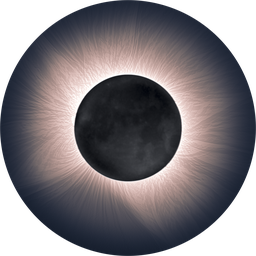
During totality the corona is thousands of times brighter next to the Moon than in its far streamers. No single photo records it all, which is why you shoot a series: very short exposures that keep the prominences and the edge of the Moon, up to exposures of a second or more that bring out the outer corona and the earthshine.
| Shutter speed | What it records |
|---|---|
| 1/4000 – 1/1000 s | Prominences, chromosphere and the edge of the Moon |
| 1/500 – 1/125 s | Inner corona |
| 1/60 – 1/15 s | Middle corona |
| 1/8 – 1 s | Far streamers |
| 1 – 2 s | Earthshine on the Moon's disc (with the inner corona already burned out) |
This is a starting point for f/6.3-f/8 and ISO 100-400, one stop apart between photos. There is no single recipe: sky transparency and the Sun's altitude change the values. Test with the full Moon, or with the filtered Sun, to see on the screen which part of the image burns at each speed.
- Everything manual: exposure, focus, white balance, and stabilisation off.
- Program the series in advance: a sequence that runs through the speeds from the shortest to the longest and starts again, with the intervalometer or the computer. In 2 min 54 s you can fit several complete rounds.
- Repeat each exposure several times. Easy Corona averages them and lowers the noise, especially in the far corona.
- Always RAW, with long-exposure noise reduction off and the same ISO throughout the series.
5
Chromosphere and earthshine
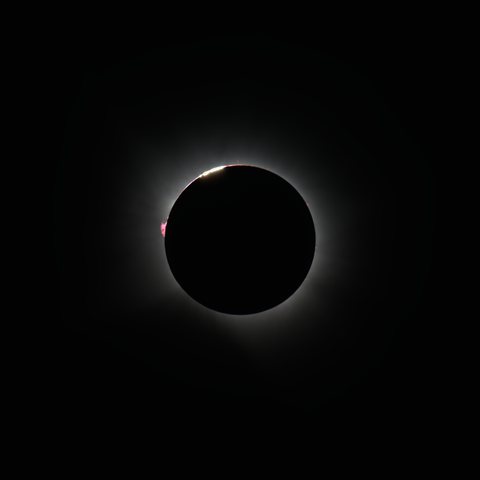
The chromosphere and the prominences show right after second contact and right before third contact, when the Moon leaves a thin edge of the Sun. Use those seconds with the fastest speeds of the series and a couple of extra shots.
Earthshine is sunlight reflected by the Earth onto the Moon. It is so faint that it only shows in long exposures, when the inner corona is already burned out. With Easy Corona you don't have to shoot them separately: from the same exposures of the series, the app suggests which ones to use for each layer.
6
Typical mistakes
- Taking the filter off too early or putting it back too late. Filter off only for the whole of totality.
- Focusing during totality. Focus beforehand, on the edge of the filtered Sun with the screen magnified, and tape the focus ring.
- A single exposure. With one photo the corona is either burned next to the Moon or gone far from it.
- Changing settings halfway through the series. Keep ISO and aperture and change only the shutter speed.
- Moving the tripod or touching the camera when changing exposure.
- Not rehearsing. Run the full sequence several times beforehand, on the filtered Sun or the full Moon.
- Watching only the screen. If the sequence is programmed, look up for a few seconds: it is the show.
7
Then, the HDR
With the series on the card, the work is in merging it: align, stack and enhance the corona. Easy Corona does it in one click.
8
Sources
- Instituto Geográfico Nacional (IGN): Total solar eclipse, August 2, 2027. Times, durations and provinces on the path.
- NASA: Total Solar Eclipse of 2027 Aug 02. Greatest duration and Saros 136.
- Xavier Jubier: interactive map of the 2027 eclipse. Times and duration at any point on the path.
- NASA: eclipse viewing safety.
Always check the times for your exact spot in the official source before eclipse day.